
How Chinese Medicine Explains Chronic Tension That Never Fully Goes Away
If tension keeps returning to the same spot no matter how much you stretch or roll, it's not a mechanical problem. It's a pattern — and patterns live deeper than muscles. Here's what Chinese medicine sees, and how we address the root.
STRUCTURAL CARE & SCOLIOSIS
Admin
7/19/20264 min read

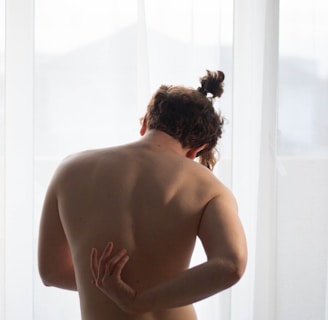
You stretch it. You roll it. You sleep differently, sit differently, adjust your desk, buy a new pillow. And the tension is still there — same spot, same familiar ache, like a knot that untangles just enough to let you forget it before pulling tight again.
I hear this from almost every patient who comes in with musculoskeletal complaints. And I heard it from my own body for years before I understood what Chinese medicine had to say about it.
The short answer is this: if tension keeps coming back to the same place, it is not a mechanical problem. It is a pattern — and patterns live deeper than muscles.
What is Chinese medicine’s understanding of chronic tension?
In Chinese medicine, the free flow of Qi (energy) and Blood through the meridian system is the foundation of physical health. When that flow is disrupted — through injury, emotional stress, postural strain, cold, or simple overuse — stagnation develops. The classical phrase is: “where there is stagnation, there is pain.”
What makes chronic tension distinct from acute pain is exactly what the word suggests: it is chronic. The stagnation has been there long enough to become the body’s new normal. Muscles that are habitually braced. Fascia that has lost its glide. Meridians that route around the blockage rather than flowing through it.
Over time, chronic stagnation can develop two additional complications that make it harder to resolve with surface-level treatments alone:
Qi and Blood deficiency.
Stagnation that has been present for a long time can begin to consume the Qi and Blood that would normally flow through that area. The tissue becomes undernourished. This is often why chronic tension feels different from a fresh injury — it has a dull, tired quality rather than a sharp, reactive one.
Cold and Damp accumulation.
When Qi doesn’t move, pathogenic factors can settle in. Cold (which causes contraction and pain that worsens in cold weather or with cold applications) and Damp (which creates a heavy, stiff, hard-to-shake quality to the tension) are the most common. People with this pattern often find that their tension feels dramatically better with heat and dramatically worse in cold or damp weather.
Why does it always come back to the same spot?
This is the question that matters most, and the one conventional physical therapy rarely answers satisfyingly.
In my research on scoliosis — the focus of my doctoral thesis — I spent considerable time studying biotensegrity: the concept that the body is held in balance through continuous tensional relationships across muscles, fascia, tendons, and ligaments. A change in tension anywhere in that system ripples through the whole. When one structure is chronically hypertonic, it pulls on everything connected to it.
What this means practically: the place where you feel the tension is often not the place where the tension originates. The tight upper trapezius is bracing against an unstable lower back. The chronic jaw tension is compensating for restricted cervical rotation. The recurring hip tightness is downstream of a pattern that begins at the foot.
This is why stretching and rolling provide temporary relief but not resolution. You are addressing the symptom without addressing the source.
What does treatment look like?
Acupuncture
Needling directly at the site of tension — and at distal points on related meridians — moves Qi and Blood through the stagnation, warms Cold, and begins to shift the pattern that is generating the problem. For chronic conditions, this is a process rather than a single event. Most people notice meaningful change within three to six sessions.
Cupping and gua sha
Both modalities work directly on the fascial layer, releasing adhesions, improving local circulation, and drawing stagnation to the surface where the body can clear it. The marks left by cupping and gua sha are the visualization of that stagnation — not bruising, but the body’s held tension becoming visible. They fade within days and often bring immediate relief to areas that needles alone cannot fully reach.
Motor point acupuncture
For deep muscular tension and particularly for musculoskeletal patterns related to structural imbalances like scoliosis, motor point needling targets the neuromuscular junction directly — releasing hypertonic muscle through its neurological root rather than its mechanical surface.
If you’ve been living with tension in the same spot for months or years and you’re tired of managing it rather than resolving it — that is exactly the kind of pattern I love to work with. My practice here in the Columbia River Valley is built around this kind of layered, root-cause approach.
And if you’ve read my piece on scoliosis and Chinese medicine, you’ll recognize many of these same principles at work — because chronic structural tension and scoliosis are, in many ways, the same conversation at different scales. Read the scoliosis post here.
Chronic tension has a root. Let’s find it.
I’m now seeing patients for acupuncture in St. Helens, OR. If tension keeps returning to the same place, let’s look at why — and build a plan that actually addresses it.
Book your first visit or join my waitlist at sashadewsnup.com.
Helping you to heal. — Sasha
RESOURCES
Tools & Reading for Chronic Tension
Myofascial Release Tools
▸ Foam roller — Superficial Back Line release along the paraspinals and hamstrings
▸ Massage ball set — for targeted trigger point work (glutes, pecs, suboccipitals)
▸ Theracane or back hook massager — for reaching the upper trapezius and rhomboids solo
Heat & Recovery
▸ Infrared heating pad — penetrates deeper than standard heat; excellent for Cold-Damp patterns
▸ Magnesium spray or bath flakes — transdermal magnesium for muscle recovery
Books
▸ Anatomy Trains by Thomas Myers — the myofascial meridian framework; a revelation for understanding chronic patterns
▸ The Mindbody Prescription by John Sarno — the psychological dimension of chronic pain
▸ Between Heaven and Earth by Harriet Beinfield — foundational Chinese medicine for the lay reader
This post contains affiliate links. I may earn a small commission at no extra cost to you. I only recommend things I genuinely believe in.
© 2026. All rights reserved.


Find Me
Email: contact@sashadewsnup.com
Phone: 503-498-5665
Address: 1561 Columbia Blvd, St Helens, OR
Hours: Thursday and Friday, 9 AM to 4 PM
Cash-pay - Superbills available
Credentialing: Moda & BCBS
Sasha Dewsnup, DAaCHM, LAc, CTRS, CCLS
Chinese medicine for nervous system regulation, maternal recovery, and structural pain — serving St. Helens and the Columbia River Valley.