
A Nourishing Summer Congee to Cool the Fire and Feed the Heart - Seasonal Recipe from the Practice Kitchen
A slow-cooked bowl of rice porridge is one of Chinese medicine's oldest prescriptions. Here's the summer version — with mung beans, lotus seeds, and goji berries — and the TCM rationale behind every ingredient.
SEASONAL RECIPE
Admin
6/28/20265 min read
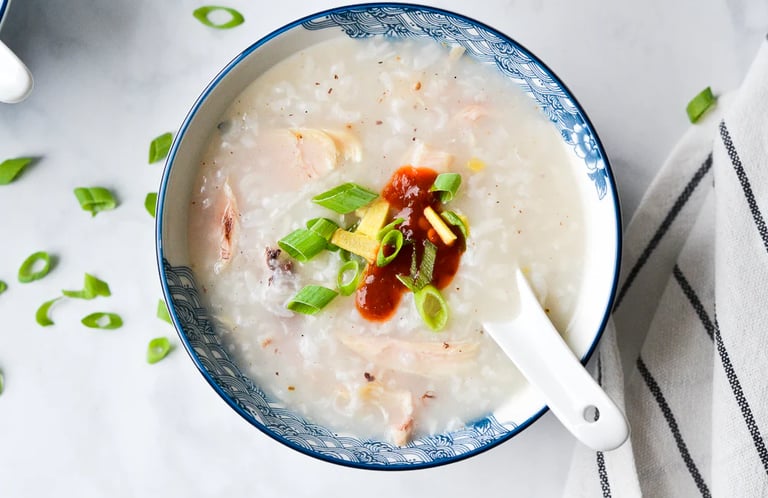
There is a bowl of food that Chinese medicine has been prescribing for thousands of years, and chances are you’ve never thought of it as medicine.
Congee — a slow-cooked rice porridge — is one of the most fundamental foods in Chinese dietary therapy. Simple, warm, and deeply nourishing, it is the first food recommended after illness, after birth, and after any period of significant depletion. It is gentle enough for the most sensitive digestion and nutrient-dense enough to genuinely restore.
In summer, when the Fire element is at its peak, we adapt congee to cool what has become overheated and nourish what the Heart needs most. This version — made with mung beans, lotus seeds, and a few simple herbs — is the one I find myself making when the days are long, the heat is building, and my body is asking to slow down.
I’m a new mother, an acupuncturist opening my practice this month in St. Helens, and someone who genuinely believes food is one of the most accessible medicines we have. I hope this recipe finds its way into your kitchen and onto your summer table.
What is congee, and why is it considered medicine?
Congee is rice cooked in a large volume of water — typically a 1:8 ratio of rice to water — over a long, slow simmer until the grains break down completely and the result is a creamy, porridge-like consistency. In Chinese dietary therapy, this cooking method matters as much as the ingredients.
Long cooking pre-digests the grain, making it extraordinarily easy for the Spleen and Stomach to absorb. In Chinese medicine, the Spleen is responsible for the transformation and transportation of nutrients — essentially your body’s ability to turn food into usable energy. When the Spleen is taxed (which, in a tired mother or an overstimulated summer body, it almost always is), easy-to-digest foods are not just pleasant. They are therapeutic.
Congee is essentially a delivery system: whatever you add to the base — herbs, grains, foods with specific thermal natures — gets absorbed efficiently and deeply.
Why mung beans and lotus seeds for summer?
Not all congee is the same. Chinese dietary therapy matches foods to seasons, constitutions, and conditions, just as herbs and acupuncture points are matched to patients.
For summer, we reach for ingredients that clear heat, calm the mind, and nourish the Heart
Mung beans (Lu Dou 绿豆) — one of the most cooling foods in Chinese dietary therapy. They clear heat and toxins, support the Liver, and reduce what is called “summer heat” — the particular heaviness and agitation that can build in the body during hot months.
Lotus seeds (Lian Zi 蓮子) — a classical Heart tonic. They calm the Shen (spirit/mind), support restful sleep, and strengthen the Spleen. If you have been anxious, scattered, or struggling to sleep, lotus seeds belong in your summer bowl.
Lily bulb (Bai He 百合) — optional but lovely. It moistens the Lungs, calms the Heart, and is specifically indicated for that frazzled, emotionally thin feeling that shows up when you’ve been doing too much for too long.
Goji berries (Gou Qi Zi 枸杞子) — a gentle Blood tonic. Sweet, warming slightly, and deeply nourishing for the Liver and eyes. A small handful added near the end of cooking gives the congee natural sweetness and a beautiful color.
The Recipe: Summer Heart Congee
Ingredients (serves 2–4)
1 cup white rice (jasmine or short-grain; brown rice can be used but requires longer cooking)
¼ cup dried mung beans (soaked for 2 hours, or overnight if planning ahead)
2 tablespoons dried lotus seeds (soaked 1 hour; remove the green center if bitter)
1 tablespoon dried lily bulb (bai he — optional; find at Asian grocery or online)
2 tablespoons goji berries, added in the last 10 minutes
8 cups water (or a light, unsalted vegetable or chicken broth for extra nourishment)
A small piece of fresh ginger (2–3 slices — warms the Spleen and aids absorption)
Rock sugar or raw honey to taste — a small amount; sweetness tonifies the Spleen
Optional garnish: fresh mint, a drizzle of sesame oil, or thinly sliced dates
Instructions
1. Prep your grains and beans.
Rinse the rice thoroughly. Drain your soaked mung beans and lotus seeds. Add everything to a large, heavy-bottomed pot along with the ginger slices and lily bulb if using.
2. Bring to a boil, then go low and slow.
Bring the pot to a boil over medium-high heat. Reduce to the lowest simmer your stove allows, partially cover, and cook for 60–90 minutes, stirring occasionally. The rice should completely break down into a thick, creamy porridge. If it thickens too fast, add water and stir.
3. Add goji berries in the final 10 minutes.
Adding them too early causes them to dissolve and lose color. You want them plump and jewel-like.
4. Sweeten gently and serve warm.
Add a small piece of rock sugar and stir until dissolved, or drizzle with a little raw honey once the congee is in the bowl. Taste and adjust.
5. Rice cooker shortcut:
If you have a rice cooker with a porridge setting, use it. Add all ingredients, set to porridge or congee mode, and walk away. It’s a genuinely magical appliance for this.
How and when to eat it
Congee is best eaten warm, in the morning or at midday. In Chinese medicine, eating warm foods in the morning supports the Spleen and Stomach, which are most active during their peak hours (7–11am on the body clock).
It keeps in the refrigerator for 3–4 days and reheats beautifully with a splash of water stirred in. Many mothers I know make a large batch at the beginning of the week and eat it for breakfast every morning. It is—genuinely—one of the most nourishing things you can do for yourself in the postpartum period or any period of significant depletion.
For postpartum mothers especially: congee is one of the foundational foods of the “zuoyuezi” (sitting the month) practice in Chinese tradition, offered to new mothers to rebuild Blood, restore Qi, and warm a body that has given so much. If you are in the Columbia River Valley and you have a new mother in your life who is struggling — a pot of congee delivered to her door is one of the most meaningful things you could bring her.
Food is medicine. So is coming in.
What you eat between treatments matters deeply in Chinese medicine. Diet is one of the four pillars of TCM — alongside acupuncture, herbs, and movement. I love sharing these recipes because they are something you can do right now, before you ever step through my door.
But food can only take you so far. If you have been depleted for a while — if you are exhausted in that deep way that sleep doesn’t fully fix, if your heart feels thin and your nervous system is frayed — come in. Let’s work together.
I am now welcoming new patients at my practice inside Well Within in St. Helens, and I would love to be part of your healing this summer.
Come in this summer.
I am now accepting new patients for acupuncture in St. Helens, OR. Let’s nourish you from the inside out — one treatment, one bowl of congee at a time.
Book your first visit or join my waitlist at sashadewsnup.com.
Resources
Kitchen Tools & Reading for TCM Nourishment
Rice Cookers
Rice cooker with porridge/congee setting — a genuine game-changer for weekly batch cooking
Instant Pot (pressure cooker mode cuts congee time to 20 minutes)
Specialty Ingredients
Dried lotus seeds — for your pantry
Dried lily bulb (bai he) — available online or at Asian grocery stores
Mung beans - for your pantry
Goji berries — quality matters; look for bright, plump berries
Cooking for Wellness Reading
The Tao of Nutrition by Maoshing Ni — practical TCM dietary guidance
Ancient Wisdom, Modern Kitchen by Yuan Wang — accessible TCM recipes
The Web That Has No Weaver by Ted Kaptchuk — foundational Chinese medicine theory
This post contains affiliate links. I may earn a small commission at no extra cost to you. I only recommend things I genuinely believe in.
© 2026. All rights reserved.


Find Me
Email: contact@sashadewsnup.com
Phone: 503-498-5665
Address: 1561 Columbia Blvd, St Helens, OR
Hours: Thursday and Friday, 9 AM to 4 PM
Cash-pay - Superbills available
Credentialing: Moda & BCBS
Sasha Dewsnup, DAaCHM, LAc, CTRS, CCLS
Chinese medicine for nervous system regulation, maternal recovery, and structural pain — serving St. Helens and the Columbia River Valley.